

An API key is a unique authentication token that identifies and authorizes an application or user when making requests to an API. More than a simple password, it serves as a programmatic credential that enables secure, automated communication between software systems while providing granular control over access, usage tracking, and rate limiting.
In modern distributed architectures, API keys form the backbone of service-to-service authentication. They allow applications to prove their identity without human intervention, making them essential for automation, CI/CD pipelines, cloud infrastructure, and third-party integrations.
However, API keys represent a critical security vulnerability: a compromised API key can expose entire systems to unauthorized access, data breaches, and service disruption.
This guide explores the technical foundations of API keys, their strategic implementation in enterprise environments, and the role of API security within zero-trust architectures.
Why API keys are critical
The business impact of poor API key practices
API key mismanagement represents one of the most prevalent yet preventable security vulnerabilities in modern software development. When developers hardcode API keys directly into source code, commit them to version control systems, or share them through insecure channels, they create attack vectors that can persist for years.
A single exposed API key can result in unauthorized access to customer data, triggering GDPR fines up to 4% of annual global turnover or PCI DSS penalties reaching $500,000 per incident. Beyond regulatory costs, organizations face reputational damage, incident response, forensic analysis, and full system remediation.
Consider the financial impact: cloud providers charge for API usage, and an exposed key can lead to resource abuse where threat actors mine cryptocurrency or exfiltrate data at your expense. Companies have reported unexpected bills exceeding $50,000 from compromised AWS credentials left in public GitHub repositories.
How modern development amplifies the need for API key management
Cloud-native architectures, microservices, and continuous deployment have fundamentally changed how applications communicate. A typical enterprise application now integrates with dozens of external services: payment processors, CRM platforms, analytics tools, cloud storage providers, and monitoring systems. Each integration requires at least one API key, often multiple keys for different environments (development, staging, production).
Microservices architectures compound this complexity. Instead of a monolithic application with a handful of external connections, you have dozens of services, each requiring credentials to communicate with databases, message queues, caching layers, and other microservices. A medium-sized deployment might manage hundreds of API keys across its infrastructure.
CI/CD pipelines introduce additional challenges. Automated deployments need access to production systems, requiring API keys for cloud providers, container registries, deployment platforms, and monitoring tools. These keys must be available to automation systems while remaining protected from unauthorized access.
The velocity of modern development creates another dimension of risk. Teams deploy code multiple times per day, often across distributed teams working in different time zones. Traditional manual key management processes cannot keep pace with this speed, leading teams to take shortcuts that compromise security.
Core principles and technical mechanics of API keys
An API key functions as a bearer token: whoever possesses the key can use it to access the associated API. This simplicity makes API keys easy to implement but requires careful handling to prevent unauthorized access.
Technically, an API key is a string of characters, typically generated using cryptographically secure random number generators (CSPRNGs). The length and format vary by implementation, but modern best practices recommend at least 128 bits of entropy. Common formats include:
UUID-based keys: 550e8400-e29b-41d4-a716-446655440000 — Human-readable but lower entropy than alternatives.
Base64-encoded random bytes: dGhpcyBpcyBhIHNlY3JldCBrZXk= — Higher entropy, compact representation.
Prefixed tokens: pk_live_51H7Zx2eZvKYlo2C8qhPjT5v — Service-specific prefixes aid in identification and automated scanning.
When a client makes an API request, it includes the key in the request, typically via:
- HTTP header:
Authorization: Bearer YOUR_API_KEY - Query parameter:
https://api.example.com/data?api_key=YOUR_API_KEY(less secure, logged in URLs) - Custom header:
X-API-Key: YOUR_API_KEY
The API server receives the request, extracts the key, and validates it against stored credentials. This validation involves:
- Existence check: Does the key exist in the database?
- Status verification: Is the key active or has it been revoked?
- Permission validation: Does this key have access to the requested resource?
- Rate limit enforcement: Has the key exceeded its usage quota?
- Scope verification: Is the requested operation within the key's authorized scope?
Modern implementations store API keys using one-way hashing, similar to password storage. The system hashes the key with a salt and stores only the hash. When validating a request, it hashes the provided key and compares hashes. This prevents key exposure even if the database is compromised.
How API Keys Integrate with the Broader Security Ecosystem
API keys rarely operate in isolation. Enterprise security architectures layer multiple authentication and authorization mechanisms to implement defense in depth.
OAuth 2.0 and API keys: Many systems use API keys as client credentials in OAuth flows. The key identifies the application, which then obtains time-limited access tokens for specific operations. This approach combines the simplicity of API keys with the security benefits of short-lived tokens.
Mutual TLS (mTLS): For highly sensitive communications, organizations combine API keys with certificate-based authentication. The client must present both a valid certificate and API key, ensuring authentication at both the transport and application layers.
IP allowlisting: Restricting API key usage to specific IP addresses or CIDR blocks adds another security layer. Even if a key is compromised, it cannot be used from unauthorized networks.
Secrets management platforms: Enterprise-grade solutions like HashiCorp Vault, AWS Secrets Manager, or Passwork provide centralized storage, access control, rotation, and audit logging for API keys. These platforms integrate with CI/CD systems, container orchestrators, and application runtimes to inject secrets at runtime without hardcoding them.
SIEM integration: Security Information and Event Management systems collect API usage logs, correlating access patterns to detect anomalies. Unusual geographic locations, request volumes, or access times trigger alerts for potential compromise.
Common Protocols, Algorithms, and Standards Involved
Several standards and specifications govern API key implementation and management:
RFC 6750 (OAuth 2.0 Bearer Token Usage): Defines how to transmit bearer tokens, including API keys, in HTTP requests. Specifies security considerations and error handling.
NIST SP 800-63B (Digital Identity Guidelines): Provides recommendations for authenticator types, including memorized secrets and cryptographic keys. Guides entropy requirements and lifecycle management.
OWASP API Security Top 10: Identifies broken authentication (API2:2023) as a critical vulnerability, emphasizing proper API key management, secure storage, and transmission.
OpenAPI Specification (OAS): Standardizes API description, including security schemes. Defines how to document API key authentication requirements, enabling automated client generation and security testing.
Cryptographic algorithms supporting API key security include:
- CSPRNG: Ensures unpredictable key generation (e.g., /dev/urandom, WebCrypto API)
- HMAC-SHA256: Creates message authentication codes for request signing
- bcrypt/scrypt/Argon2: Hashes API keys for secure storage
- AES-256: Encrypts keys at rest in secrets management systems
Strategic Implementation: A Step-by-Step Guide
Phase 1: Assessment and Discovery
Begin by identifying all API keys currently in use across your organization. This discovery phase reveals the scope of the challenge and establishes a baseline for improvement.
Inventory existing keys: Scan code repositories, configuration files, CI/CD systems, and deployment manifests. Tools like git-secrets, TruffleHog, and GitGuardian automate detection of accidentally committed credentials. Document each key's purpose, owner, permissions, and last rotation date.
Assess current practices: Interview development teams to understand how they currently manage API keys. Identify pain points, workarounds, and security gaps. Common issues include:
- Keys shared via email or chat
- Production keys used in development environments
- No rotation policy or audit trail
- Unclear ownership and lifecycle management
Risk classification: Categorize keys by sensitivity. Production database credentials and payment processor keys require stricter controls than read-only analytics API keys. This classification informs access policies and rotation schedules.
Compliance mapping: Identify regulatory requirements affecting API key management. SOC 2 requires access controls and audit logging. PCI DSS mandates encryption of stored credentials and quarterly access reviews. GDPR demands data protection by design and default.
Phase 2: Tool Selection and Integration
Choose a secrets management solution that aligns with your infrastructure, team size, and security requirements.
Evaluation criteria:
- Deployment model: Cloud-hosted (AWS Secrets Manager, Azure Key Vault) or self-hosted (HashiCorp Vault, Passwork)
- Integration capabilities: Native support for your CI/CD platform, container orchestrator, and application frameworks
- Access control granularity: Role-based access control (RBAC), attribute-based access control (ABAC), or policy-based controls
- Audit and compliance features: Detailed logging, compliance reports, and SIEM integration
- High availability: Replication, failover, and disaster recovery capabilities
- Cost structure: Per-secret pricing, API call limits, or flat licensing
Open-source vs. commercial considerations:
Open-source solutions like HashiCorp Vault offer flexibility and community support but require expertise to deploy, configure, and maintain. You're responsible for high availability, backup, and security hardening.
Commercial platforms provide managed services, support contracts, and compliance certifications but may have vendor lock-in and higher costs. Cloud-native options integrate seamlessly with their respective ecosystems but may not suit multi-cloud or on-premise requirements.
Self-hosted solutions like Passwork offer enterprise features with complete control over data residency, making them ideal for regulated industries or organizations with strict data sovereignty requirements.
Integration implementation:
Modern secrets management platforms provide multiple integration methods:
- REST API: Over 100 endpoints for programmatic access and automation
- CLI utilities: Command-line tools for developer workflows and scripting
- SDKs: Language-specific libraries (Python, Go, JavaScript) for application integration
- Container sidecars: Inject secrets into containers at runtime without modifying application code
- CI/CD plugins: Native integrations for Jenkins, GitLab CI, GitHub Actions, and CircleCI
Phase 3: Policy Enforcement and Automation
Establish clear policies governing API key lifecycle management and enforce them through automation.
Key generation standards: Define requirements for key entropy, format, and metadata. Automated generation ensures consistency and prevents weak keys. Include prefixes that identify the key type and environment (e.g., prod_api_, dev_api_).
Access control policies: Implement least privilege principles. Grant access to specific keys based on job function, not blanket access to all secrets. Use temporary access grants for troubleshooting or one-time operations.
Rotation schedules: Establish rotation frequencies based on risk classification:
- Critical production keys: 30-90 days
- Standard API keys: 90-180 days
- Low-risk read-only keys: 180-365 days
Automate rotation where possible. Many cloud services support automatic rotation with zero-downtime key transitions. For services without native support, implement blue-green key rotation: generate a new key, update all consumers, verify functionality, then revoke the old key.
Revocation procedures: Document and automate the process for emergency key revocation. When a key is compromised, you need to:
- Immediately revoke the key in the secrets management system
- Identify all systems using the key
- Generate and distribute a replacement key
- Verify that all systems have updated credentials
- Audit logs for unauthorized usage of the compromised key
Automated scanning: Implement pre-commit hooks and CI pipeline checks that prevent committing secrets to version control. Tools like git-secrets and Talisman block commits containing patterns matching API keys, passwords, or private keys.
Phase 4: Monitoring, Auditing, and Optimization
Continuous monitoring and regular audits ensure your API key management practices remain effective as your infrastructure evolves.
Usage monitoring: Track API key usage patterns to establish baselines for normal behavior. Monitor:
- Request frequency and volume
- Geographic origin of requests
- Time-of-day patterns
- Accessed resources and operations
- Error rates and authentication failures
Anomaly detection: Configure alerts for deviations from established baselines:
- Requests from unexpected geographic locations
- Sudden spikes in API calls
- Access attempts outside business hours
- Multiple authentication failures
- Requests for unauthorized resources
Audit logging: Maintain comprehensive logs of all secret access:
- Who accessed which secrets and when
- Changes to access policies or permissions
- Key generation, rotation, and revocation events
- Failed access attempts
Retain logs according to compliance requirements (typically 1-7 years) and protect them from tampering through write-once storage or cryptographic signing.
Regular access reviews: Quarterly reviews identify unused keys, over-privileged access, and orphaned credentials. Automated reports should flag:
- Keys not used in the past 90 days
- Keys with broader permissions than required
- Keys without clear ownership
- Keys that haven't been rotated according to policy
Performance optimization: Monitor the performance impact of secrets management on application startup time and request latency. Implement caching strategies for frequently accessed keys while maintaining security boundaries.
Advanced Concepts and Future Trends in API Key Management
Exploring Zero-Trust Architectures and API Keys
Zero-trust security models assume no implicit trust based on network location or previous authentication. Every request must be authenticated, authorized, and encrypted, regardless of origin.
In zero-trust architectures, API keys evolve from static credentials to dynamic, context-aware tokens. Instead of long-lived keys with broad permissions, systems issue short-lived tokens with minimal scope for specific operations.
Workload identity: Modern platforms like Kubernetes and cloud providers offer workload identity systems. Applications authenticate using cryptographically verifiable identities tied to their runtime environment, eliminating the need for static API keys. AWS IAM Roles for Service Accounts (IRSA) and Azure Managed Identities exemplify this approach.
Service mesh integration: Service meshes like Istio and Linkerd handle service-to-service authentication using mutual TLS, automatically rotating certificates and enforcing access policies. API keys become unnecessary for internal communication, reserved only for external integrations.
Policy-based access control: Instead of granting broad permissions to an API key, zero-trust systems evaluate each request against dynamic policies considering:
- The requesting identity and its trust level
- The requested resource and operation
- The current security posture of the requesting system
- Contextual factors like time, location, and recent activity
The Role of AI and Machine Learning in API Key Security
Machine learning enhances API key security through behavioral analysis and threat detection.
Behavioral biometrics: ML models learn normal usage patterns for each API key, detecting subtle anomalies that rule-based systems miss. Models consider request timing, resource access patterns, parameter distributions, and error rates to identify potentially compromised keys.
Automated threat response: When anomalies are detected, AI-driven systems can automatically:
- Temporarily suspend suspicious keys pending investigation
- Require additional authentication factors for high-risk operations
- Adjust rate limits to contain potential abuse
- Alert security teams with contextual information for rapid response
Predictive security: ML models analyze historical breach data and current threat intelligence to predict which keys face elevated risk. This enables proactive rotation or additional monitoring before compromise occurs.
Natural language processing: NLP models scan code repositories, documentation, and communication channels for accidentally exposed credentials, understanding context to reduce false positives.
Emerging Standards and Technologies
The API security landscape continues to evolve with new standards addressing API key limitations.
SPIFFE/SPIRE: The Secure Production Identity Framework For Everyone provides a standardized way to identify and authenticate workloads in heterogeneous environments. SPIRE, the reference implementation, issues short-lived cryptographic identities that replace static API keys.
OAuth 2.1: The upcoming OAuth 2.1 specification consolidates best practices and deprecates insecure patterns. It emphasizes PKCE (Proof Key for Code Exchange) for all clients and mandates secure token storage.
FAPI (Financial-grade API): This specification defines security profiles for high-risk applications like financial services. It requires mutual TLS, signed requests, and strict token validation, setting a high bar for API security.
WebAuthn and FIDO2: While primarily designed for user authentication, these standards are being adapted for application authentication, using hardware security modules or secure enclaves to protect cryptographic keys.
Quantum-resistant cryptography: As quantum computing advances, current cryptographic algorithms face obsolescence. NIST is standardizing post-quantum cryptographic algorithms, which will eventually replace current key generation and signing methods.
How Passwork Enables Best-in-Class API Key Management
Passwork provides enterprise-grade secrets management designed specifically for modern DevOps and IT teams. As an on-premise solution, Passwork gives you complete control over your API keys and sensitive credentials while delivering the automation and integration capabilities teams need.
Comprehensive secrets storage: Passwork securely stores all types of credentials essential for modern infrastructure: API keys for external services, access tokens for cloud providers (AWS, Azure, GCP), database passwords, SSH keys, TLS/SSL certificates, connection strings, service account credentials, and JWT secrets.
Zero-trust architecture: Passwork implements double encryption with a zero-trust model. Data is encrypted on the client side before transmission, then encrypted again on the server. The server never has access to unencrypted data, ensuring protection even from privileged administrators. Each password and vault receives unique encryption keys, with a complete chain of protection from master password through PBKDF2-derived keys, RSA-2048 key exchange, and AES-256 encryption.
DevOps and CI/CD integration: Passwork provides multiple integration methods to fit your workflow:
- REST API: Over 100 endpoints for complete programmatic control
- CLI utility: Terminal-based management for scripts and automation
- Python SDK: Direct application integration for programmatic access
- Docker image: Simplified deployment in container-based CI/CD pipelines
Native support for GitLab, Jenkins, Docker, Kubernetes, and other DevOps platforms ensures seamless integration with your existing toolchain.
Granular access control: Set precise permissions for users, teams, or applications. Implement least privilege principles with role-based access control that determines exactly who can access which secrets.
Automated secrets rotation: Update API keys with instant propagation across all connected systems. Passwork's rotation capabilities ensure zero-downtime credential updates, eliminating the manual coordination that often delays security improvements.
Enterprise compliance: Passwork holds ISO/IEC 27001 certification, demonstrating systematic information security management. For organizations in regulated industries, Passwork offers the compliance documentation and audit capabilities required by SOC 2, PCI DSS, and GDPR.
Flexible deployment: Passwork adapts to any corporate infrastructure, from isolated offline environments to high-availability cloud deployments. Integration with LDAP, Active Directory, and SAML SSO provides seamless authentication, while SIEM connectivity enables comprehensive security monitoring.
By centralizing API key management in Passwork, organizations eliminate hardcoded secrets, reduce the risk of credential exposure, and gain complete visibility into secret access across their infrastructure.
Best Practices for API Key Management
1. Never hardcode API keys in source code
Store keys in environment variables, configuration files outside version control, or dedicated secrets management platforms. Use placeholder values in committed code and inject actual keys at runtime.
2. Implement key rotation schedules
Regular rotation limits the window of opportunity if a key is compromised. Automate rotation where possible and maintain overlapping validity periods to prevent service disruption.
3. Use different keys for different environments
Production, staging, and development environments should have separate API keys. This isolation prevents accidental production access during development and limits the impact of compromised development credentials.
4. Apply the principle of least privilege
Grant each API key only the minimum permissions required for its specific purpose. Avoid using master keys or admin-level credentials for routine operations.
5. Monitor and audit key usage
Track all API key access and usage patterns. Set up alerts for anomalous behavior and regularly review access logs to identify potential security issues.
6. Secure key transmission
Always transmit API keys over encrypted connections (HTTPS/TLS). Never include keys in URLs where they may be logged by proxies, load balancers, or browser history.
7. Implement rate limiting and quotas
Protect against abuse by limiting the number of requests per key within a time window. This contains the damage from compromised keys and prevents resource exhaustion attacks.
8. Document key ownership and purpose
Maintain clear records of what each API key is used for, who owns it, and when it was created. This documentation is essential for incident response and regular access reviews.
9. Establish revocation procedures
Have a documented process for immediately revoking compromised keys. Test this process regularly to ensure you can respond quickly in an emergency.
10. Use secrets scanning tools
Implement automated scanning in your CI/CD pipeline and periodically scan existing repositories for accidentally committed secrets. Configure pre-commit hooks to prevent secrets from entering version control.
Frequently Asked Questions
What is the difference between an API key and an API token?
The terms are often used interchangeably, but technically, an API key is typically a long-lived credential that identifies an application, while an API token (especially in OAuth contexts) is usually short-lived and may carry specific permissions or scopes. Tokens are often obtained using API keys as client credentials.
How long should an API key be?
Modern best practices recommend at least 128 bits of entropy, which translates to approximately 22 characters in base64 encoding or 32 hexadecimal characters. Longer keys provide additional security margin against brute-force attacks.
Can API keys be safely stored in environment variables?
Environment variables are safer than hardcoding but have limitations. They can be exposed through process listings, error messages, or logging. For production systems, use dedicated secrets management platforms that provide encryption, access control, and audit logging.
How often should API keys be rotated?
Rotation frequency depends on risk level. Critical production keys should be rotated every 30-90 days, standard keys every 90-180 days, and low-risk keys annually. Immediate rotation is required if compromise is suspected.
What should I do if an API key is accidentally committed to GitHub?
Immediately revoke the key and generate a replacement. Even if you delete the commit, the key remains in Git history and may have been scraped by automated scanners. Treat any committed key as compromised.
Are API keys sufficient for production security?
API keys alone provide basic authentication but lack advanced features like automatic expiration, fine-grained scopes, and user context. For production systems, consider layering API keys with OAuth 2.0, mutual TLS, or workload identity systems for defense in depth.
How do I manage API keys in microservices architectures?
Use a centralized secrets management platform that integrates with your container orchestrator. Inject secrets at runtime through environment variables, mounted volumes, or sidecar containers. Implement service mesh for internal communication to eliminate the need for API keys between services.
What compliance frameworks address API key management?
SOC 2 requires access controls and audit logging for credentials. PCI DSS mandates encryption of stored authentication credentials and quarterly access reviews. ISO 27001 requires documented information security controls. GDPR requires data protection by design, which includes secure credential management.
Passwork is an EU-based company with a trusted name in cybersecurity delivering enterprise-grade password management solution designed for organizations that demand full control over their security infrastructure.
With on-premise deployment at its core, Passwork ensures complete data ownership, zero-knowledge encryption, and compliance with industry regulations — backed by ISO 27001 certification.

Passwork is an EU-based company with a trusted name in cybersecurity delivering enterprise-grade password management solution designed for organizations that demand full control over their security infrastructure.
- Unified security ecosystem: Secure password sharing, secrets management, RBAC, and real-time auditing in a single solution.
- On-premise deployment: Host on your infrastructure with complete data sovereignty. Only your team accesses sensitive data.
- Zero-knowledge architecture: End-to-end encryption keeps your data protected at all times, in transit, at rest, and during processing.
- Seamless integration: Robust API, LDAP, and SSO support for effortless integration with existing services and DevOps pipelines.
- Easy onboarding: Intuitive interface, straightforward deployment, and minimal learning curve.
- Verified security: ISO 27001 certified and pentested by HackerOne.
Take the first step today. Start your free Passwork trial and see how easy secure password management can be.
Table of contents
Table of contents
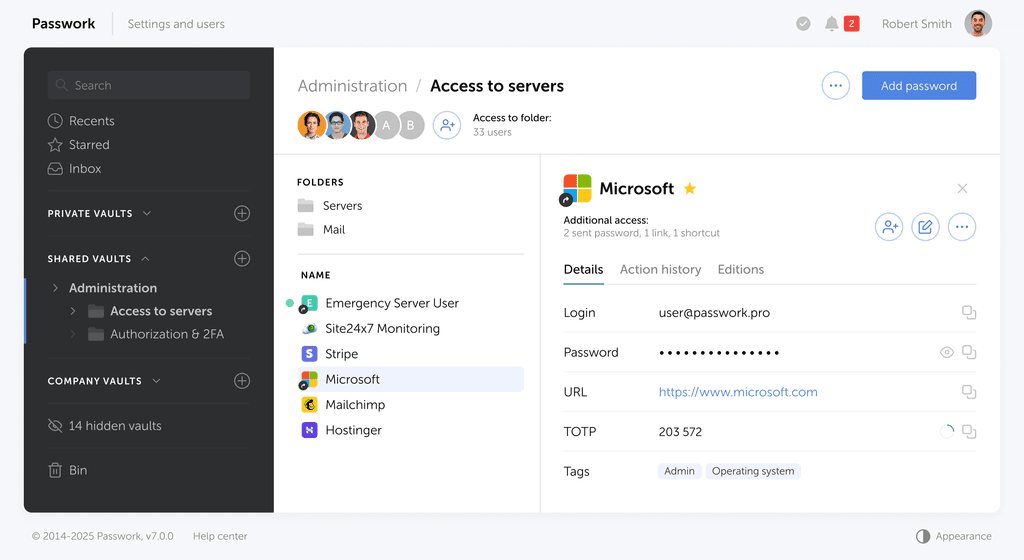
Self-hosted password manager for business
Passwork provides an advantage of effective teamwork with corporate passwords in a totally safe environment. Double encryption and zero-knowledge architecture ensure your passwords never leave your infrastructure.
Learn more